 2% bank transfer discount
 EU delivery with FedEx
 Free shipping from €500
TEIN FS2: Coilover with External Reservoir
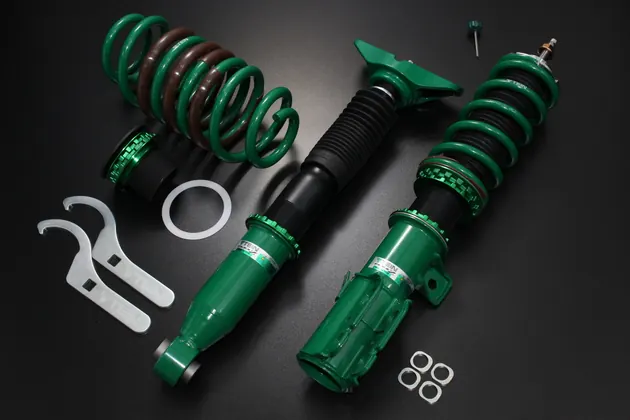
TEIN FS2 is aimed at drivers who want more precise differentiation in damping tuning. The series includes an external reservoir, height adjustment via the spring seat, and two adjustment options: a combined adjustment of rebound and compression damping and an additional adjustment for compression damping. Both offer 16 steps each. This is a different operating concept than a coilover with only one adjustment dial. Here you will learn how to classify these functions, what information you need before ordering, and why a documented baseline setting is more important than many changes at once.
Discover coilovers · Compare suspension concepts · Check vehicle data correctly
Understanding FS2: two adjusters with different roles
In everyday use, an adjustable damper is often simply called "adjustable hardness." For comparing different suspensions, this is too imprecise. Compression damping describes the damping effect during compression, rebound damping during rebound. On the FS2, one adjustment changes both together. The second adjustment additionally affects the compression damping. This combination must not be described as a fully independent setting of rebound and compression damping. Those looking specifically for separate circuits must carefully compare the technical description of each series.
The two adjusters are therefore not two identical comfort regulators either. With a change of the combined setting, you change the baseline to which an additional compression damping adjustment relates. For a usable setup, you need a documented baseline. Note the intended baseline values, vehicle height, and the used wheel-tire combination. This way, you can return after a change and assess whether the desired behavior has actually changed.
What does an external reservoir do?
The external reservoir is an additional component connected to the damper in the hydraulic system. In this design, not all of the necessary compensation volume is arranged exclusively in the main housing. The specific design influences how the system processes oil movement and volume changes. The reservoir is thus a functional component and not just a visual feature signaling a sporty look.
For you, this mainly creates an additional installation requirement. The container and possibly its connection must be installed in the specified locations. Moving axle parts, heat sources, sharp edges, and full steering lock must be taken into account. The secure position results from the vehicle-specific instructions. Arbitrary mounting at any free spot is not an equivalent alternative. Clarify before purchase whether the intended installation concept fits the already existing modifications on the vehicle.
Twin-tube dampers and H.B.S.
FS2 uses a twin-tube concept. Working and compensation areas are arranged in two concentric tubes. Together with the specific valve tuning, this creates the damping behavior. However, the word "twin-tube" alone neither implies a general comfort advantage nor a fixed ranking compared to other designs. What matters is how the entire suspension is tuned to the vehicle, springs, and application.
TEIN also names Hydraulic Bump Stop, or H.B.S., for FS2. This system supplements the hydraulic damping effect in the designated range near the end of the compression travel. It is not a permission to choose the installation height outside the specifications. Sufficient suspension travel and a suitable baseline setting remain necessary. Bump stops or other parts must not be changed without corresponding installation instructions. If a vehicle constantly hits the stops during operation, the cause should be checked rather than just choosing a firmer adjuster position.
Height adjustment via the spring seat
Vehicle height on FS2 is adjusted via the dedicated spring seat. This distinguishes the series from an full-length adjustment via a separate lower mount. The change of the spring position relates to the usable working range of the suspension. Therefore, height and suspension travel must be considered together. Which dimensions are specified depends on the specific application and its design.
A lowering should be based on your actual use conditions. Think about driveways, bumps, load, and the existing wheels. A vehicle may show enough space in the wheel well at rest but still have too little clearance during compression. Plan to check the necessary range of movement. The adjustment limits and related documentation specified on the product page take precedence over a general series image or a height you have seen on another vehicle.
How do you proceed with tuning?
Start with the condition of the vehicle. Worn bearings, unsuitable tires, or incorrect wheel alignment cannot be compensated by additional damping adjusters. After proper installation, first set the intended baseline values. Only then does comparing different settings make sense. Record your observations specifically: in which driving situation do you notice the behavior, at what load, and after which change?
Then change preferably only one parameter at a time. If you simultaneously change both adjusters, the height, and tire pressure, many possible causes for the outcome arise. Small, documented steps are easier to evaluate. There is no general click combination that is best for every vehicle and driver. The two 16-step settings do not provide a universal number for "comfort" or "sport." They serve tuning within the constructively design limits.
EDFC and manual operation
Whether and how electronic control is intended must be checked for the specific FS2 set and desired components. Do not transfer statements on EDFC compatibility of another TEIN series uncritically to your application. Relevant are among others the adjustment mechanics, available installation space, and the appropriate combination of motors and control. The EDFC guide explains the basic system and the role of individual components.
Consider before accessory purchase which settings you actually want to reach conveniently. An electronic adjuster does not replace the necessary baseline setting. It also does not turn a combined adjuster into separate rebound and compression damping control. The mechanical functional principle of the damper is decisive. A clear description of how you want to use the controls helps avoid unnecessary or unsuitable accessory combinations.
Realistically compare scope of delivery and installation costs
Compare offers based on the complete part number. Check included springs, bearings, mounts, reservoir holders, and all parts to be reused from the vehicle. With different axle designs, the structure between front and rear axle can differ significantly. General product photography does not reliably depict these differences. For your order, the description of the selected product counts.
Overall effort includes the coilover, installation, possibly necessary wear parts, wheel alignment, and required documents. Checking street use is different from purely mechanical vehicle allocation. Therefore clarify before purchase which documents are available or required for your exact set and your country. The designation of a product series is neither a report nor a vehicle-specific approval.
Compare FS2 with other TEIN concepts
If you mainly seek uncomplicated height and damping adjustment, also take a look at FLEX Z. If you want to retain an OE-style damper layout and adjust the damping, EnduraPro PLUS offers a different concept for your comparison. None of these alternatives is automatically better or worse just because of their number of adjusters. Choose according to application, conversion goal, and the effort you want to plan for a systematic adjustment.
Start in the shop with your complete vehicle data and then compare the technical specifications on the suitable item. For open questions, model, production period, equipment, and TEIN part number help. Via the contact form you can transmit this information together. Our pages on payment options and shipping information assist you with further planning.