 2% bank transfer discount
 EU delivery with FedEx
 Free shipping from €500
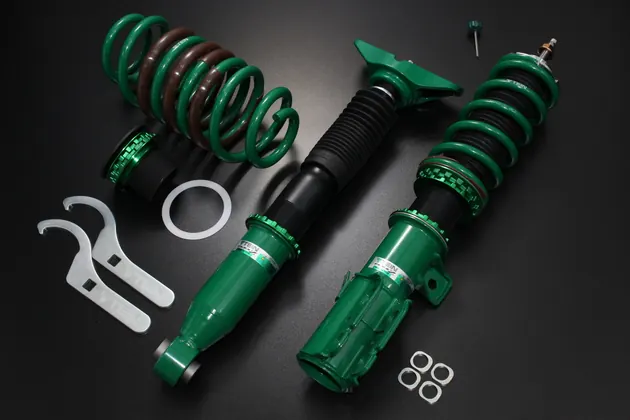
TEIN FLEX AVS: adjustable ride height with factory AVS
You want to change the height of your Toyota or Lexus while continuing to use the existing adaptive damper control? This is exactly where TEIN FLEX AVS comes in, at the interface between mechanical suspension and vehicle electronics. The series is designed for selected vehicles with AVS. The starting point is the equipment fitted to your exact vehicle version. This guide explains what the system does, how to define your conversion goal and what information you should compare before ordering.
View coilover suspensions · Identify your vehicle specification · Compare suspension solutions
What does FLEX AVS stand for?
AVS here refers to the Adaptive Variable Suspension System of certain Toyota and Lexus models. TEIN describes FLEX AVS as a coilover suspension that allows height adjustment while continuing to use the AVS function. The damping is influenced by the existing AVS actuator. According to TEIN, the suspension does not provide manual damping adjustment. If you specifically want a manually operated adjustment knob, you should know this difference before choosing a product.
This means the series answers a different question than a suspension where you adjust damping yourself in individual clicks. Your choice depends on which control concept you want to keep. So before comparing, write down which functions you use in the vehicle today and what you like about the current driving behavior. Is it mainly about a different vehicle height, replacing worn parts, or a self-selected damping setup? These goals do not necessarily lead to the same product.
Distinguish spring, damper and electronic control
The spring carries the vehicle load and allows the wheel to move relative to the body. The damper limits the speed of this movement. Its effect therefore depends not only on how far the vehicle is compressed, but also on how fast the damper parts move. Electronic control changes the damping characteristics within the intended possibilities. However, it does not make the damper a freely programmable replacement for any other suspension component.
For your purchase decision this means: a change in damping is not a change in spring rate. Also, a different vehicle height cannot be explained solely by an electronic driving mode setting. Keep these three terms separate when comparing offers. This way you can better read technical descriptions and avoid judging the entire driving experience from one feature. Statements like “more comfortable” or “sportier” have limited significance without vehicle condition, tires, and usage.
How is the vehicle height adjusted?
For FLEX AVS, TEIN names an overall length adjustment, twin-tube dampers and a hydraulic end stop, known as H.B.S. According to the manufacturer, existing bump stops are still required even with H.B.S. The installation height and adjustment ranges applicable to your vehicle result from the specific application. The series name does not imply one lowering figure that applies to every model.
Plan your desired height based on your everyday use. A visual impression from a photo says little about how the car works with your wheels, a full load or the slope of your driveway. A description of your requirements is useful: daily commute, frequent passengers, luggage, poor side roads or a steep driveway. With such information, a workshop can better assess a setting than with just wanting the smallest figure at the wheel arch.
A subsequent height change is also a change in the coordinated overall condition of the car. Therefore document the actually chosen setting. If later tires, rims or other suspension components are added, you have a clear baseline. Avoid making several changes simultaneously by feel. Otherwise it is hard to tell which change caused a new noise, a different steering reaction or a clearance restriction.
What vehicle information do you need?
Start with manufacturer, model, exact version and production period. The date of first registration is when the vehicle was first registered; it may differ from its production month. Add the type code and relevant suspension equipment. A model name or a sporty trim alone does not prove your vehicle actually has the supported AVS system. For an already converted used car it is additionally important which components are actually installed.
Then compare the information on the TEIN part number. Pay attention to restrictions and notes in each offer. If the vehicle selection shows several similar versions, do not decide only by the product image. Pictures can illustrate a series while mounts or other parts vary between applications. Our vehicle selection guide helps you sort the terms. It does not replace assigning a specific part number to your equipment.
Electronic damper control and EDFC
The vehicle-side AVS and a retrofitted electronic control are different concepts. Therefore do not automatically transfer statements about another TEIN suspension or an EDFC system to FLEX AVS. An electronic function on two products does not mean the same connection, operation, or general compatibility. For ordering, the explicitly documented combination of the specific components counts.
If you compare different control concepts, start with the result you want to achieve. Do you want to continue using existing vehicle functions or conveniently control your own damping settings? Our EDFC guide explains the separate TEIN concept and its components. Buy accessories only when the suitability for your specific suspension is clarified. An additional control unit is not a blanket solution for unclear vehicle electronics.
Plan installation and initial condition together
A new suspension works together with many parts already present in the vehicle. Have the condition of nearby bushes, mounts and other relevant components assessed before conversion. A worn joint will not automatically be repaired by a new coilover suspension. A thorough inventory also helps avoid wrongly attributing noises later to the new product.
Agree with your workshop which operations and checks the installation includes. Depending on the application, these include setting the intended ride height, checking component clearance and testing the electronic functions according to the manufacturer’s instructions. Axle geometry and possibly other necessary calibrations should be considered in the installation plan. The specific procedures, torque specifications and adjustment values belong in the corresponding installation instructions and are not replaced here by general figures.
Scope of delivery, documents and later maintenance
Check before ordering which parts are actually included in the selected set and which existing parts are reused. Check the listing for the exact kit contents. Also note the documents needed for your application. Vehicle compatibility and the documents required for the intended modification are separate checks. A general series description does not establish approval for a specific vehicle.
After installation, keep part number, installation documents and setup record together. This facilitates later maintenance and spare part inquiries. Clean and inspect the suspension according to the specified care instructions, especially when exposed to road dirt and salt. In case of irregularities, first ask for an inspection of the specific component. Which spare or service option is available must be clarified by part number; a service concept description is not a delivery commitment.
Your next step
FLEX AVS is suitable for your comparison if you want to combine a height adjustment with the existing AVS concept for a supported vehicle model. First find your vehicle, then read the information about the specific set and compare equipment, installation target, and documents. This sequence turns a general series selection into a well-informed order. For practical planning, you will also find our shipping information and the payment options.