 2% bank transfer discount
 EU delivery with FedEx
 Free shipping from €500
TEIN FLEX Z coilovers
TEIN FLEX Z is a coilover series for drivers who want to coordinate ride height and damping deliberately. A suspension conversion starts with a practical question: should the car mainly look different, feel more settled on familiar roads, or offer settings you can understand and reproduce? Those aims do not necessarily call for the same adjustment. This guide explains how to assess the available functions, which vehicle details matter when buying, and what should be completed before the first journey with your new suspension.
Choose coilovers · Compare vehicle details · Understand suspension basics
FLEX Z: understanding the series specification
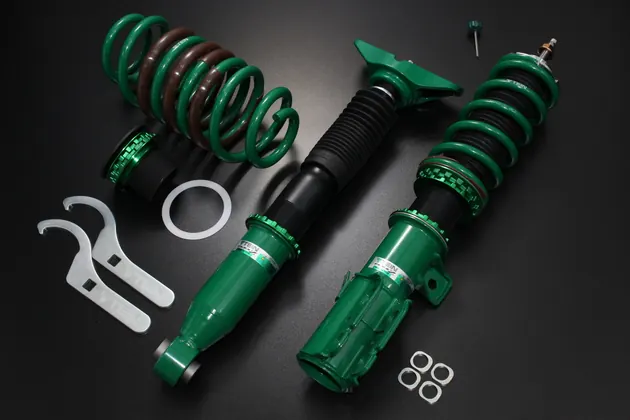
The supplied TEIN catalogue places FLEX Z in the road suspension range and lists height adjustment, adjustable damping and twin-tube construction. The series uses sealed damper units, so its replacement arrangements need to be considered when planning future repairs. Upper mounting arrangements differ between applications. A general series photograph therefore cannot establish which top mount, or whether camber adjustment, is included for every vehicle. Always compare the exact manufacturer part number and its technical information.
The word coilover initially tells you something about suspension construction and height adjustment. It does not, by itself, establish which mounts are supplied, whether electronic control is possible or which settings suit your intended use. FLEX Z is worth considering when you want to adjust damping as well as height. If you intend to retain the original ride height and existing springs, look instead at shock absorbers in original-equipment shape. This keeps the comparison connected to the change you actually want.
Separating ride height, spring preload and suspension travel
A lower body position, a different spring preload and a change in the damper's working travel are three separate matters. Avoid experimenting with every threaded collar. The instructions for your kit identify the function of each component and the required starting dimensions. A design with a separate lower mounting bracket can use a different adjustment method from an axle with the spring mounted separately from the damper. The procedure must match the actual axle layout.
Decide on the intended ride height before the workshop appointment. Consider driveways, parking ramps, normal loads and your wheel-and-tyre combination. A position that looks attractive while parked may leave insufficient clearance with the steering turned or the rear suspension compressed. The range mentioned in a product description also needs to be considered alongside the applicable installation documents. Not every mechanically reachable position is suitable for driving. Clearance and remaining travel must be assessed together.
Making useful damping adjustments
FLEX Z provides 16 levels of adjustment that change compression and rebound together. The spring supports the load; the damper controls movement. More damping resistance does not turn a soft spring into a stiffer spring. Turning an adjuster also cannot compensate for insufficient travel or an unsuitable wheel combination. The adjustments are tools for achieving a suitable setup, rather than a ranking in which the stiffest position is always the best.
Begin with the installation instructions and record the initial positions. Then change one clearly identified setting and assess the result on a familiar route under normal driving conditions. Left and right settings must be appropriate for the axle concerned. If you simultaneously change tyre pressures, ride height and several dampers, it becomes difficult to identify what caused the difference. A short written setup record is more useful than copying an arbitrary click count from another car.
Putting twin-tube construction into context
In a hydraulic shock absorber, wheel movement produces piston movement and oil flow that resist motion. Heat is generated in the process. A twin-tube layout has a compensation space in addition to the working chamber. However, valve settings, stroke, springs, vehicle mass and tyres also influence the result. Construction type alone cannot reliably predict how comfortable your particular car will feel. Compare the characteristics relevant to the application rather than relying only on technical labels.
Even a well-designed damper must work within its intended range of movement. Bump stops and dust protection serve separate purposes and must not simply be removed. A noise after installation does not necessarily originate inside the damper either. Mounts, incorrectly loaded fasteners or contact between other components may be involved. Have the cause investigated systematically before trying a supposedly better adjuster position as a cure.
Check top mounts and wheel alignment
Depending on the vehicle, the kit may specify rubber mounts, spherical-bearing mounts or reuse of existing mounting components. These differences matter for installation, noise transmission and possible geometry adjustments. An adjustable top mount in a series illustration does not confirm that your chosen kit contains that part. Read the individual product information and installation instructions; the complete TEIN part number is essential when requesting clarification.
Changing ride height may require the wheel alignment to be checked and adjusted. Toe and camber affect the tyre contact patch and wear, but they must be assessed alongside vehicle requirements and intended use. Arrange the necessary work together with installation. This avoids judging a newly fitted suspension while its alignment remains unchecked. Control-arm bushes, joints and tyre condition also form part of the starting point.
Electronic adjustment with EDFC
On expressly compatible FLEX Z applications, EDFC can operate the damping adjusters. It does not electrically change ride height. Before ordering, check that the controller, motor kit, available installation space and suspension application are compatible. A controller on its own is not a complete conversion kit. Our EDFC guide explains the components and helps you prepare a precise compatibility enquiry.
First establish how accessible the manual adjusters will be after installation. Trim panels or the position of the damper head may make access difficult. Electronic operation may then be of interest, but suitability still needs to be established for the particular application. Select EDFC components using the documented part assignment rather than a similar-looking illustration.
Find the right kit and prepare the installation
Start with the manufacturer, model, chassis or type code and production period. Add drivetrain, body style and relevant factory equipment, especially electronically controlled original suspension. First registration may be later than production. This distinction matters around model changes. A shared model name is insufficient if TEIN excludes particular versions. Every restriction in the selected product information remains part of the fitment decision.
Check the documents applicable to your specific vehicle before purchasing. A general series description does not replace application-specific evidence. The workshop should know the supplied parts, components to be reused and any additional replacement parts needed before installation begins. Plan a documented initial setup and the appropriate checks afterwards. For future maintenance enquiries, retain the part number, installation date and current settings together with the instructions.
It also helps to explain your priorities in everyday terms. Describe the roads you normally use, whether passengers or luggage are frequently carried and what you dislike about the present setup. These observations provide a much more useful starting point than simply requesting the lowest or hardest setting. They do not replace the technical limits of the selected kit, but they help organise the installation and adjustment discussion.
Choose your vehicle and compare the available TEIN coilovers. Our service pages explain payment and the bank-transfer discount and delivery within the EU. For a focused enquiry, send the model, type code and intended part number to info@tein-germany.com.
Further series information: TEIN FLEX Z from the manufacturer. The specific product information and installation instructions take precedence.